The ones we found afterwards
NASA/JPL close-approach data joined to the Small-Body Database · US Government work, not subject to copyright · 1900–2100 · 1,697 passes inside the Moon’s orbit
A cron reloads the source table from JPL at 05:40 UTC; the dataset refresh re-reads it at 06:25 and rebuilds the wasm extract. A newly discovered object brings its past approaches with it, so a reload can add a pass from 1911.
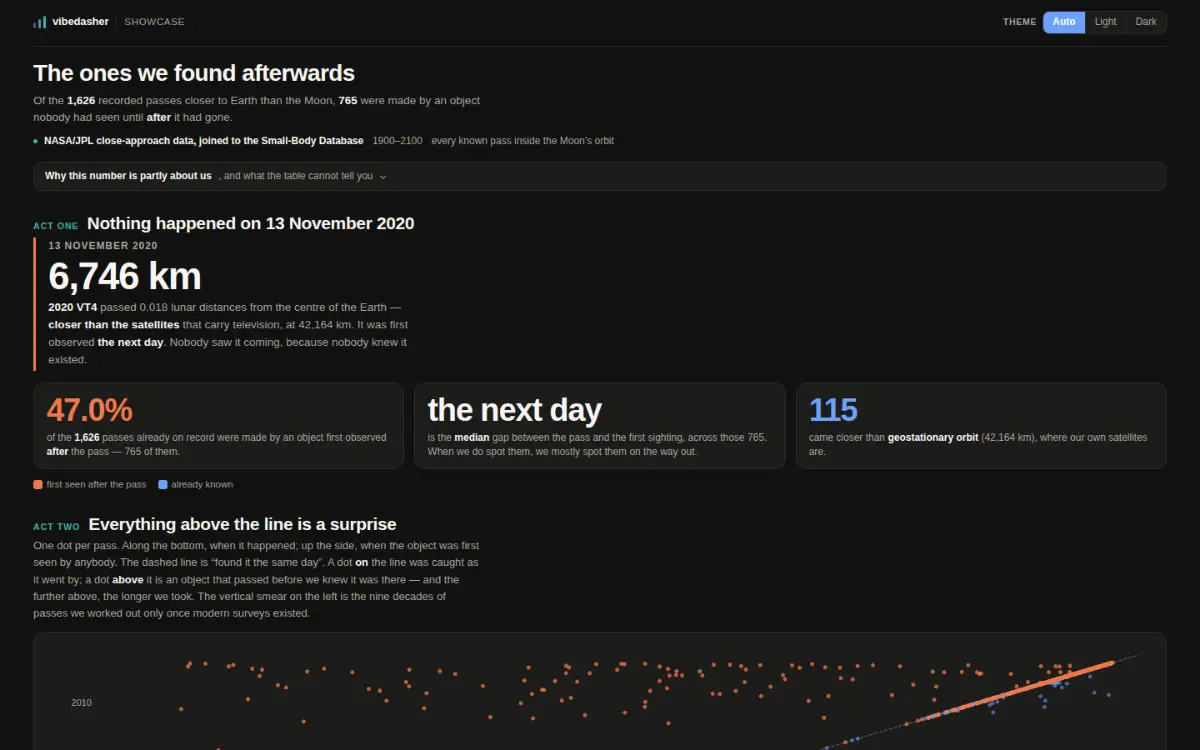
Una captura de pantalla del panel publicado, tomada desde la misma dirección que cualquiera puede abrir.
- Vía de datos
- Vía de consulta
- Por vista
- 115.8 KB descargados, 1 extracción
- Antigüedad
- a fecha de 2026-10-08
- Accesibilidad
- se abre sin cuenta
Medido contra el host en vivo, sin ninguna credencial, el 2026-10-09.
La pregunta que responde
How often does something pass closer to us than the Moon — and did we see it coming?
Los datos, y de qué periodo
JPL’s close-approach table for every pass inside one lunar distance, joined to the Small-Body Database for when each object was first seen.
Cómo obtiene sus filas
One query, in your browser, with no key.
Qué vuelve
1,697 rows × 14 columns — one S3 GET, no compute.
Qué fue difícil
Distances are measured from the Earth’s centre, so the geostationary ring is 42,164 km and not the 35,786 km altitude. Using the altitude undercounts the passes inside the satellite ring by nineteen.
Qué pasó después de construirlo
Refreshed daily.
El panel en sí
Abrir el panel en vivoEl panel se carga desde el host de visualización. No se descarga nada de él hasta que lo pidas, así que esta página no toca ese origen sin tu permiso.
https://share.vibedasher.com/eu/vibedasher/the-ones-we-found-afterwards?exec=wasm
Lo que se carga aquí es el panel publicado, desde la misma dirección que abriría cualquier otra persona — no una copia mantenida a mano. La imagen fija de arriba es una captura de pantalla de esa misma dirección.
Publicado por Vibedasher